Physical Address
304 North Cardinal St.
Dorchester Center, MA 02124
Physical Address
304 North Cardinal St.
Dorchester Center, MA 02124

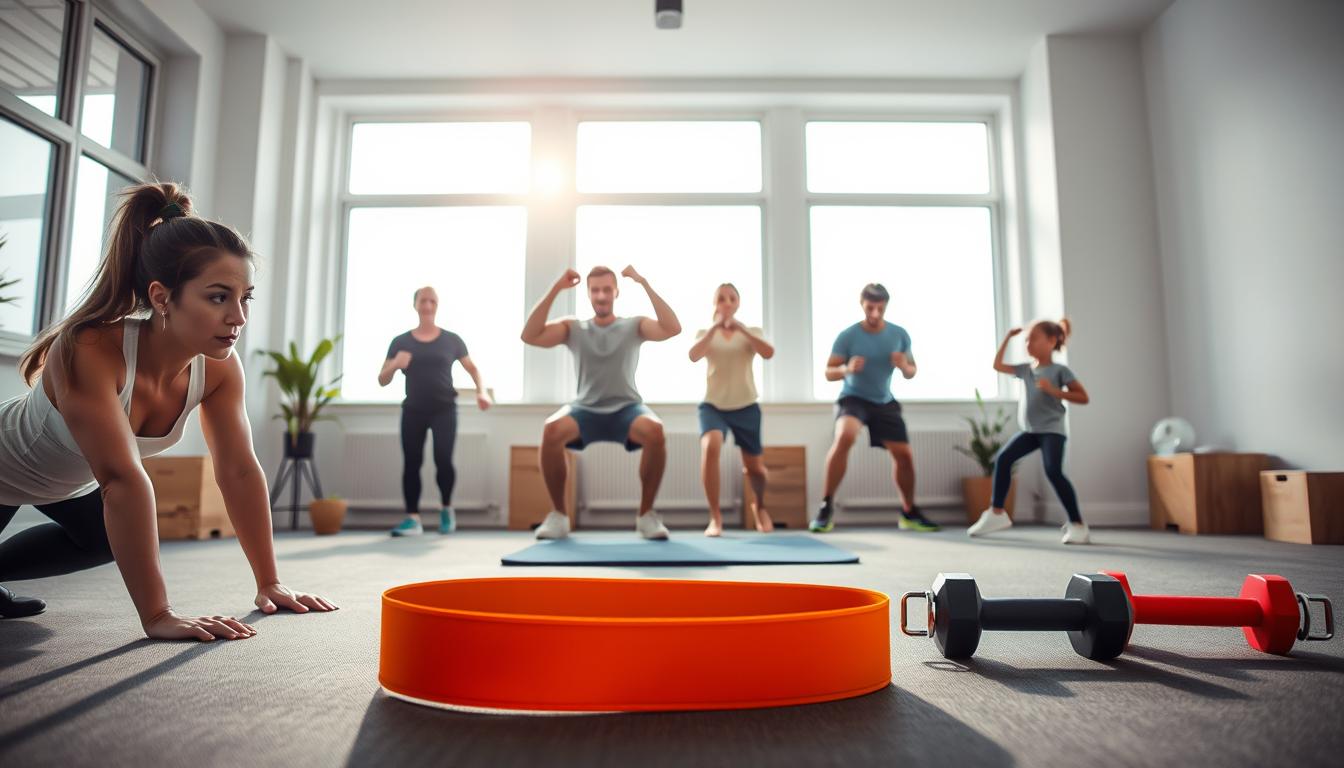
Fact: I learned that a 15-minute bodyweight AMRAP can deliver a greater training stimulus than steady treadmill running at 85% HRmax for the same time.
I use that hard fact as a starting point to plan fast, effective sessions I can do in my living room. My approach pairs yoga poses and strength training moves so I can build muscle, improve aerobic fitness, and manage fat mass with no gear.
Typical beginners follow a short circuit—10–15 reps for two sets with 30–60 seconds rest—and finish in 15–20 minutes. I favor circuits and AMRAPs because they save time and keep intensity high.
My promise: I’ll show clear structure, progressions, and form cues so you protect your back and joints while increasing strength and muscle. This is for beginners easing in, intermediates chasing progression, and advanced athletes who still want to challenge their body.
I choose bodyweight sessions now because they let me protect my joints while still making real gains. Training at home removes friction—no commute or waiting for machines—so I can start in minutes and stay consistent.
Bodyweight work scales easily for a beginner or an advanced lifter. I can change range of motion, tempo, or leverage to alter intensity. That means the same core movements teach solid technique and let me focus on form before adding load.
Many of my short HIIT-style sets match or exceed the cardio stimulus I used to chase on a treadmill. I pair mobility and stability drills with strength training to build a resilient body that moves well in daily life.
A focused circuit of five to eight moves gives me measurable progress in a single short session.
I outline a beginner-friendly plan that finishes in 15–20 minutes: 10–15 reps per move, two rounds, and 30–60 seconds rest between rounds. This rep-based approach keeps the session simple and safe for someone new to bodyweight exercises.
For an intermediate challenge I switch to timed rounds—one minute per exercise, two cycles—or I run an AMRAP to push intensity when I have limited time. Both formats deliver strong stimulus and help me hit weekly activity targets: aim for at least 150 minutes of moderate or 75 minutes of vigorous activity per week.
| Format | Duration | Intensity | Best for |
|---|---|---|---|
| Rep-based circuit | 15–20 min | Moderate | Beginners learning form |
| Timed rounds | 12–20 min | High | Intermediates managing pacing |
| AMRAP | 10–20 min | Very high | Experienced trainers chasing stimulus |
I use these simple structures as my go-to way to train when time is tight. They let me work the whole body, stay consistent, and make each session count.
Research shows that well-structured bodyweight training can push my cardiovascular system and grow muscle in surprisingly little time. I base my sessions on studies that measure real changes in the body, not just feelings.
Bodyweight work improves mobility and stability because I move through full ranges and control every rep. That practice also teaches technique and reduces joint stress compared to heavy lifting.
Consistency matters more than gear. Zero setup means I do more sessions, which reinforces skill and accelerates adaptation for my muscles and aerobic system.
One Kennesaw State University study found a 20-minute CrossFit style AMRAP beat steady running at 85% HRmax for overall stimulus. Another paper in the Journal of Exercise Science & Fitness showed press-up training at a load similar to 40% 1RM produced comparable hypertrophy and strength gains over eight weeks.
“Short, focused bodyweight sessions can deliver a meaningful training stimulus for both strength and aerobic capacity.”
Bottom line: bodyweight movements are a reliable foundation. They let me train often, push intensity, and prepare my body for heavier work later if I choose to increase load.
I always start by checking alignment — it saves my joints and improves every rep. Small adjustments make a big difference for safety and progress.
Proper alignment reduces joint stress and the risk of injury. I use clear anchors so I can feel when my position is right.
In this way I keep my body ready for every exercise and reduce wear on my joints.
I begin with simple moves that teach control and build a reliable foundation for every session. These patterns help me learn tension, breathing, and joint position before I add intensity.
I lie on the floor, press through my feet, and squeeze at the top. The bridged march adds single‑leg load while keeping my pelvis stable.
I sit back to touch a chair, then drive through heels. This builds depth, balance, and the squat pattern safely.
From a high plank on my knees I lower with elbows ~45° and keep a straight line. I only progress when form is rock solid.
I lower to parallel in a split stance and push through the front heel. Step-ups train each leg and improve balance.
I hold forearm planks 30–60 seconds and lift the top leg without rotating in side‑lying abductions. Bird Dog and Dead Bug lock in spine control.
I move slowly, alternating elbow to knee while keeping my lower back on the floor for safe core tension.
Beginner circuit: 2 sets of 10–15 reps per move (or timed holds) with 30–60 seconds rest. I keep hands under shoulders and feet grounded, adjusting reps by level.
| Move | Target | Reps / Hold | Progression |
|---|---|---|---|
| Bridge / Bridged march | Glutes, posterior chain | 10–15 reps | Single‑leg bridge |
| Chair squat | Quads, squat pattern | 10–15 reps | Full bodyweight squat |
| Knee push-up | Chest, triceps | 8–15 reps | Standard push-up |
| Forearm plank | Core, spine | 30–60 sec | Plank with leg lift |
To bridge beginner gains and harder sessions, I layer targeted progressions that keep intensity high and form intact. These moves add balance, time under tension, and extra shoulder demand so each session feels tougher without adding gear.
I advance to forward-backward lunges to challenge balance and control through a bigger range of motion for each leg. The step-reverse pattern forces stability and trains single-leg strength.
I pair that with pike push-ups to load my shoulders and upper arms more. Pike push-ups shift bodyweight toward the shoulders and build pressing strength safely.
Kneeling squats keep constant tension and build leg endurance while protecting the knee. I use slow descents and controlled rises to increase time under tension.
Superman reps train the posterior chain—move slowly and squeeze at the top. I then upgrade planks by adding alternating leg lifts to raise core demand and teach anti-rotation control.
I attack the lateral core with kneeling side planks plus hip abduction to light up the glute med and improve side stability. This helps carry strength into single-leg moves and daily tasks.
When I need a real challenge, I turn to advanced bodyweight moves that test strength, balance, and control. These variations force me to keep strict form while raising intensity.
I progress bridges by extending the free leg to increase unilateral glute and hamstring demand. The overhead squat then adds a mobility and core test. I cue wide feet placement and steady hands overhead before each rep.
For my upper body, I use one-legged push-ups and elevated pike push-ups to hit shoulders and arms. I control the descent and finish each rep with a solid brace so my shoulders stay healthy.
I add jumping lunges for explosive power, landing softly to protect joints. Side planks with hip abduction train lateral strength, and hollow holds to jackknifes force constant core tension while keeping the lower back on the floor.
Routine: 2 sets of 10–15 reps per exercise with 30–60 seconds rest, or one set each, rest 1–2 minutes, then repeat. I count reps and prioritize quality over volume.
| Move | Target | Reps | Progression |
|---|---|---|---|
| Single-leg bridge (leg extended) | Glutes, hamstring | 10–15 | Elevated single-leg bridge |
| Overhead squat | Mobility, core | 8–12 | Narrow stance; increase depth |
| One-legged push-up | Chest, arms, shoulder | 6–12 | Archer push-up to full single-arm |
| Jumping lunges | Legs, power | 10–15 each | Pistol-assisted jump |
| Hollow hold → jackknife | Core, anti-extension | 20–30 sec / 8–12 | Add slow negatives |
I keep a short list of go-to moves that cover every pattern my body needs. These choices let me build simple, balanced sessions fast.
Squats, lunges, and step-ups train quads and balance. I add jumping lunges for power and supported pistol squats to load one leg safely.
I rely on push-ups and chair dips to hit chest, shoulders, and arms. Star plank variations add anti-extension strength for the shoulder girdle.
Planks, side planks, Dead Bug, Bird Dog, V-sits, and oblique crunches build core without stressing the spine. Keep hands steady on the floor and press through full feet in standing moves.
When I want a conditioning spike, I use burpees, handstand wall walks (advanced), crab walks, or spider crawls. These recruit stabilizers and tax the whole body.
| Pattern | Example move | Primary target | Progression |
|---|---|---|---|
| Lower | Supported pistol | Single-leg strength | Full pistol |
| Upper | Push-up | Chest & triceps | One-leg or elevated |
| Core | Forearm plank | Anti-extension | Leg lifts |
| Total-body | Burpee | Conditioning | Burpee + tuck jump |
“Pair unilateral moves to bring up weak links and finish with one high-output finisher.”
I pick five to seven moves, set a 20-minute cap, and let structure create intensity for the whole body. This keeps each session tight and repeatable on busy mornings or evenings.

Two rounds of 10–15 reps per exercise with 30–60 seconds rest finishes in about 15–20 minutes. I choose chair squats, knee push-ups, bridged marches, lunges, and a short plank.
Tip: keep hands under shoulders and check feet placement before each set so knees track over mid-foot.
I run one-minute stations: push-ups, squats, a row/brace variation, alternating lunges, and a plank variation. Repeat the circuit twice for a solid time-based workout that builds strength and conditioning.
For a high stimulus, I do a 20-minute AMRAP rotating push-ups, squats, and a core hold or Dead Bug. I chase steady pace and clean form rather than sprinting and breaking technique.
“Short, structured circuits let me earn a big training return in minimal time.”
I design compact training blocks that force progressive overload using tempo, range, and volume rather than weight. This keeps each session short and measurable while letting me push for real adaptations with bodyweight moves.
I program 2–4 sets per exercise and aim for 6–20 reps depending on the goal. I use slow eccentrics, controlled pauses, and full range of motion to increase time under tension.
Practical tweaks: add a rep, add a set, slow the lowering, extend the pause, or increase range to create steady overload. I bias moves that let me feel the target muscles and keep joint‑friendly mechanics.
“Press‑up training at loads similar to 40% 1RM produced comparable hypertrophy and strength gains over eight weeks.”
I spread push, squat/lunge, hinge/bridge, and core across three sessions each week. That mix lets me hit 150 minutes of moderate or 75 minutes of vigorous activity by adding a couple of AMRAPs or timed rounds.
| Focus | Sets | Reps | Tempo |
|---|---|---|---|
| Strength | 3–4 | 6–8 | Controlled pause, slow eccentric |
| Hypertrophy | 2–4 | 8–15 | 2–3s lowering, full ROM |
| Conditioning | 1–3 | AMRAP or timed | Brisk pace, short rest |
By tracking sets, reps, and rest I can build strength and build muscle over weeks while training at my place. This method keeps progress clear and repeatable for every workout.
I prioritize spine-safe abdominal work to protect my back while building real core strength. I pick moves that keep the lower back flat and emphasize steady breathing. Short holds and controlled reps beat flashy crunches for long-term results.
I hold a forearm plank with a straight line from head to feet and avoid hip sag. Aim for 30–60 seconds and stop if my form slips.
Progressing with alternating leg lifts raises stability demands. That variation trains anti-rotation and anti-extension while keeping the spine neutral.
Dead Bug and Bird Dog force core activation while the lower back stays flat on the floor. I do controlled reps—about 8–12 per side—to reinforce deep control.
Hollow hold to jackknife gives sustained abdominal tension without repeated spinal flexion. I treat each set as a posture drill: long body line, active glutes, braced midsection, and quiet hands and arms.
My leg sessions focus on simple, repeatable moves that build real lower-body strength and improve daily movement. I pair squats and split variations with targeted posterior work to balance effort across the front and back of the hips.

I start with bodyweight squats and split variations to hit quads and glutes while keeping knees tracking over the feet. Chair-supported squats teach depth and a safe squat movement.
Lunges and step-ups train each leg, build balance, and add functional strength. I control depth, slow the lowering, and make every rep count to avoid heel lift or knee cave.
I use bridges and single-leg bridges on the floor to load glutes and hamstrings. The single-leg bridge challenges stability and unilateral power.
Superman reps finish the set, targeting the lower back, glutes, and hamstrings. Small tweaks—stance width, split depth, foot position—shift which muscles work hardest, so I vary those to progress.
I focus push days on clear pressing patterns that train chest, shoulders, triceps, and the core at once. I build sessions that protect my shoulders and keep technique strict so every rep counts.
I progress from knee push-ups to standard push-ups, then to pike and elevated pike variations to shift load toward the shoulders. Pike and elevated pike push-ups increase vertical stress and target shoulder muscle more than flat presses.
Keep elbows at roughly 45° on the descent to protect the shoulder joint and maintain a straight line from head to heels in plank‑based positions. I add a one‑second pause at the bottom to increase time under tension without extra weight.
Chair dips load the triceps through a long range while also recruiting chest and shoulders. I cue elbows pointing back, shoulders down and packed, and a neutral neck so my back stays happy.
| Progression | Primary target | Tip |
|---|---|---|
| Knee → Standard push-up | Chest, triceps | 45° elbow angle; straight plank line |
| Pike → Elevated pike | Shoulders, upper chest | Increase vertical angle slowly |
| Chair dips → Close-grip dip | Triceps, chest | Elbows back; shoulders down |
“Progress steadily and respect shoulder comfort—modify rather than force a pinchy position.”
I step up my training by changing how I move, not by adding gear. Small, consistent tweaks deliver real results and keep joints healthy.
I expand range of motion first — deeper squats and fuller push‑up depth increase demand before I make a move more complex.
I then adjust leverage: inclines, declines, or narrow support change load while using the same movement patterns.
Stability follows. Single‑arm or single‑leg variations, staggered stances, and slow tempo add challenge safely once the base feels automatic.
I add hops and jumps only after I can land softly and keep knees tracking. Plyometrics like jumping lunges are powerful but need solid mechanics.
Unilateral moves come next to fix side‑to‑side gaps and raise intensity without external weight. I progress in small steps over weeks, not days, and track how each exercise feels so I can adjust the next session.
| Path | Example | Why |
|---|---|---|
| Range | Deeper squat / Full push‑up depth | More muscle work per rep |
| Leverage | Incline → decline push‑up | Adjusts load without gear |
| Stability | Single‑leg bridge | Fix imbalances, build strength |
I structure short, timed formats so every minute counts and every rep has a purpose. These protocols let me turn limited minutes into real training stimulus. They fit my schedule and keep intensity honest.

I use AMRAPs to accumulate high volume of quality reps in a set time. A 20-minute AMRAP can produce a strong stimulus when I pick compound, bodyweight exercises that move the whole body.
EMOMs give me scheduled work and brief recovery. I set clear sets and pace so fatigue is manageable and technique stays sharp.
Ladders—ascending reps—let me increase volume without burning out. They add reps gradually and keep every set crisp.
I keep rest short but I stop a set before form breaks. That protects joints and keeps progress steady.
“Short timers and clear goals help me push intensity with crisp technique, not frantic speed.”
I rely on smart recovery and steady nutrition to turn short sessions into real muscle gains.
I train three full‑body sessions per week and progress by adding reps, extending holds, or slowing tempo. On other days I keep moving—walks, mobility drills, or light active recovery so my back and joints stay loose.
I spread protein across the day to support repair. That means protein at each meal and after a tough session.
I aim for 7–9 hours of sleep because better rest equals stronger sessions and fewer aches. When I feel beat up I schedule a light day so muscle tissue can rebound.
I keep simple, measurable metrics: total reps per workout, best plank holds, and clean push‑up counts. Tracking these shows steady gains in strength and size over time.
“Consistency plus recovery beats sporadic intensity when you want lasting muscle.”
At fifty-plus, I prioritize movement choices that protect joints while still pushing strength and balance. No-equipment bodyweight moves remain effective for building muscle and for daily function. I focus on form, controlled tempo, and progress that feels steady at my level.
I favor inclines—hands on a bench or table—to reduce shoulder stress and keep my arms comfortable during presses. I use partial ranges when mobility limits the full pattern, then deepen range as tolerance improves.
Slowing tempo increases time under tension without adding weight and protects knees and back.
I make balance a priority with step-ups, split squats, and side planks. These moves mimic daily movement and raise unilateral leg strength to lower fall risk.
“Simple, consistent sessions at home let me build real strength without setbacks.”
I set a 20-minute timer and build a full session from six low-setup moves. My quick-start plan: two rounds of 8–12 reps of squats, incline or standard push-ups, lunges, glute bridge, a 30–45s plank, and Dead Bug (each side), with ~30s rest as needed.
Key cues: keep hands and feet placed the same each set, keep a straight line from head to feet in the plank, and avoid hip sag. Use a chair to learn squat depth and control.
How I run it: move briskly between exercises, track reps and time, and repeat this workout three days this week to build momentum without burning out.





Spotted wc99game and decided to jump in. It’s alright, you know? Got some games to kill time with. Nothing groundbreaking, but it’s decent enough for a quick session. Give it a go! wc99game